

Most players pick their playbook based on their favorite team or whatever looks good on the selection screen. At the competitive level, that decision is already costing you games before you've taken a single snap.
A playbook isn't just a collection of plays. It's a system, a set of answers to every problem a defense can throw at you. When I sit down to evaluate a playbook, I'm not asking "what plays look cool?" I'm asking, "Does this give me everything I need to win a close game against a great opponent?" There's a difference. And over the years of playing at a high level, I've developed a checklist I run through every time. Here's what's on it.
Step One: Can I Beat a Heavy Blitz?
This is the first thing I look for, before anything else. If I can't answer a Cover 0 mid blitz or a pinch buck 0, nothing else in the playbook matters. Heavy blitz defenses are designed to overwhelm you before you can process the field, and if you're not prepared for them, they feel impossible to move the ball against. But when you know what you're looking at, they can turn into a one-play touchdown.
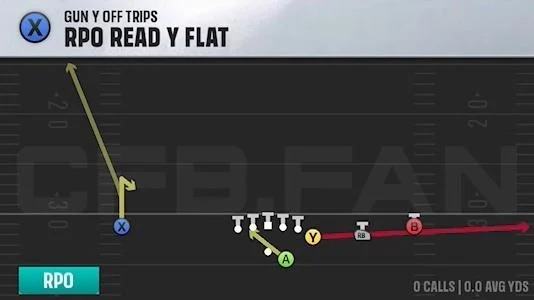
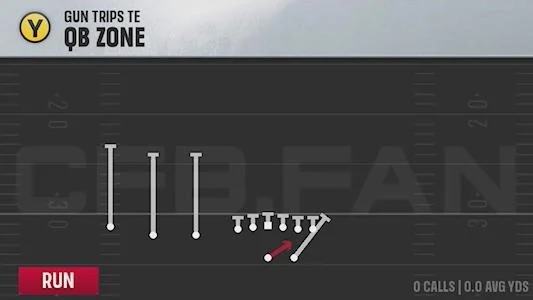
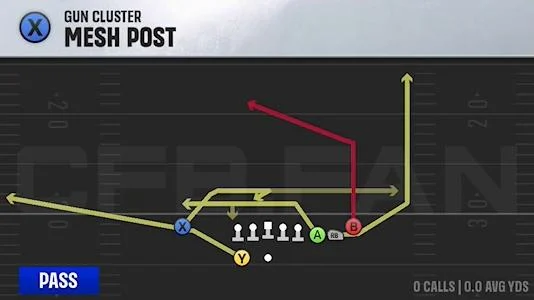
What I need in a playbook to answer pressure: good QB zone plays, outside zones, RPO Read Y Flats, sharp quick-cutting stock routes, and mesh concepts. Mesh is particularly underrated against these blitz-heavy looks. When everyone on defense is either focused on getting to the quarterback or locked in man coverage, mesh routes cause defenders to literally run into each other. The crossing action creates natural picks, lanes open up, and what should be a chaotic play turns into a big gain.
The foundation of my entire playbook evaluation starts here. Everything else builds on top of having a reliable answer to pressure.
Redzone Efficiency: Settling for 3 Is a Losing Strategy
At the competitive level, the difference between winning and losing games often comes down to what you do inside the 20. Settling for a field goal when you had a chance at 7 is a swing that compounds over four quarters. I need a playbook that gives me high-percentage ways to score touchdowns in the red zone, not just get close.
Over the last two years, QB Zone from Trips TE in the Alabama playbook has been one of my most reliable redzone weapons. The design of that play in a compressed redzone environment is just hard to stop when you know how to run it.
RPOs are the other piece of this. A good RPO keeps the defense completely on their heels because they literally cannot commit to stopping both the pass and the run simultaneously. In CFB 25, RPO Read Y Flat from Gun Y Off Trips Nasty was almost a guaranteed 6 points inside the redzone. You could high ball the tight end on the flat route and the defense had almost no answer for it. EA made adjustments in CFB 26 by adding the ability to hot route RPOs, which makes them significantly harder to defend and adds a new layer of decision-making at the line. Having a solid RPO in your arsenal going into CFB 27 is non-negotiable.
Stock Routes That No Hot Route Can Replicate
This is something a lot of players don't think about until they've been playing at a high level for a while. The hot route tree you have access to at the line of scrimmage does not run the same as the stock routes built into specific plays. There's a difference in the stem, the break, and the sharpness of the cut. At the competitive level, that difference is everything.
The two routes I prioritize finding in a playbook are sharp corners and sharp posts. The corner in a play like Corner Strike from Bunch Str Offset and the post in Mesh Post from Gun Cluster are routes that kill man coverage consistently. What makes them elite is that even when your opponent guesses right, even when they shade their coverage inside or outside, knowing these routes are coming, they still get open. That's a rare quality in this game.
These routes also sit perfectly behind zone coverage when you stem your receiver to the right depth before the snap. Against a soft zone, a properly stemmed sharp corner or post finds the void every time. I need plays with these stock routes built in, because you simply cannot replicate them with a hot route.
The Power Play: Making Cover 3 and Cover 4 Pay
Every competitive playbook needs at least one play where I can look at what the defense is giving me and know without any guesswork that I'm about to score. When my opponent settles into Cover 3 or Cover 4 with no adjustments, I need something that punishes that decision immediately.
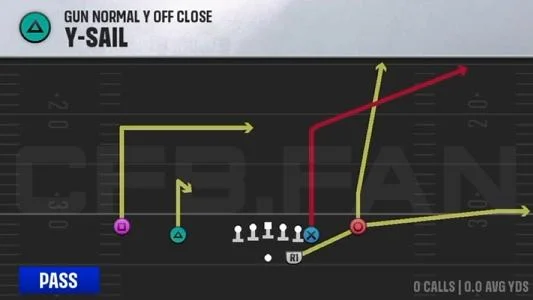
Two plays that have worked well for me in this role are Y Sail from Normal Y Off Close and Flood from Gun Bunch Strong Offset. Both of these plays feature unique fade routes that attack the soft spot that naturally exists between the cornerback and the safety when they're each responsible for a deep third of the field. That gap between defenders is a design flaw in Cover 3 and the right fade route exploits it. You call the play, read the coverage, and let the route do the work.
Play Action: The Pro Tip Most Players Don't Know About
Here's something that doesn't get talked about enough. If your opponent has the Quick Jump ability on their pass rushers, running play action cancels it out. It resets the engagement and gives your offensive linemen a better chance at winning their individual rep. That alone makes play action a tactical chess move, not just a way to set up deep shots.
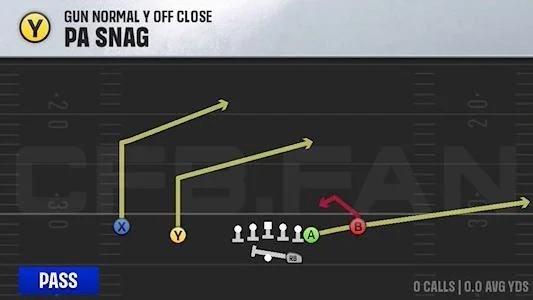
The play action plays I look for in a playbook are ones that already have strong route designs built in, specifically plays with a good stock post route as a built-in option. Normal Y Off Close PA Snag and Y Off Trips Nasty PA Double Post are two examples that check that box. Both give me a reliable post route to work with, and from there, I can freestyle hot route the rest of the receivers based on what the coverage is giving me.
This becomes especially important later in games. When your opponent's pass rusher abilities upgrade to Platinum or even Heisman level in the fourth quarter, the pressure they can generate changes the dynamic of every passing play. Having play action in your back pocket as a built-in ability counter is a detail that separates good players from great ones.
Formations You Can Actually Live In
Know yourself. This sounds simple, but it's something a lot of players ignore when they're picking a playbook. I know I'm most comfortable in compressed bunch sets: Gun Bunch TE, Gun Bunch Str Offset, Gun Bunch X Nasty. 3x1 formations make the field easier for me to read because each receiver is attacking a different area, which simplifies my pre-snap reads and my post-snap progressions.
I also know I'm not great from 2x2 sets. Doubles and Spread formations don't play to my strengths, so I don't build my playbook around them. That's not a weakness I'm ashamed of; it's self-awareness that makes me a better competitive player. Build your system around what you do well, not around what looks impressive.
Once I've identified two or three formations I can audible between during a game, I ask myself one more question: does each formation have at least four plays I can call from it, including at least one solid run? If my opponent can tell what play I'm running based solely on my formation, I've already lost the mental battle. Four audible options per formation keep them guessing.
The Run Game: More Than Just Yards
A reliable run game in a competitive playbook serves three purposes that go beyond simply moving the chains.
It keeps your opponent honest. If your opponent can guess pass on every single play and be right, your offensive line never gets a chance to settle in. A credible run threat forces them to defend the full field.
It improves your passing game. When your opponent has to respect the run, your offensive line wins more reps, your quarterback has more time, and your receivers get cleaner releases off the line.
It controls the clock. Toward the end of each half, being able to run the ball consistently and drain your opponent's timeouts is a skill that decides close games. If I can pick up 4 or 5 yards on first down running the ball, I'm setting myself up for a manageable 3rd and short instead of a 3rd and long. 3rd and 2 is a completely different game than 3rd and 8.
Final Thought
A playbook is a system. Every play in it should serve a purpose, answer a specific defensive problem, or put you in a position to win a critical down. When I evaluate a playbook, I'm not looking for 500 plays, I'm looking for the right 20 that cover every situation I'll face in a competitive game.
Blitz answer. Redzone touchdown plays. Routes that can't be replicated. A power play vs soft coverage. Play action as a counter. Formations you're comfortable in. A run game with real purpose. Check all seven boxes, and you've got a playbook built to compete, not just to play.
What does your competitive playbook checklist look like? Drop it in the comments. I'd genuinely love to see how other top players are building their systems heading into CFB 27.

Comments